
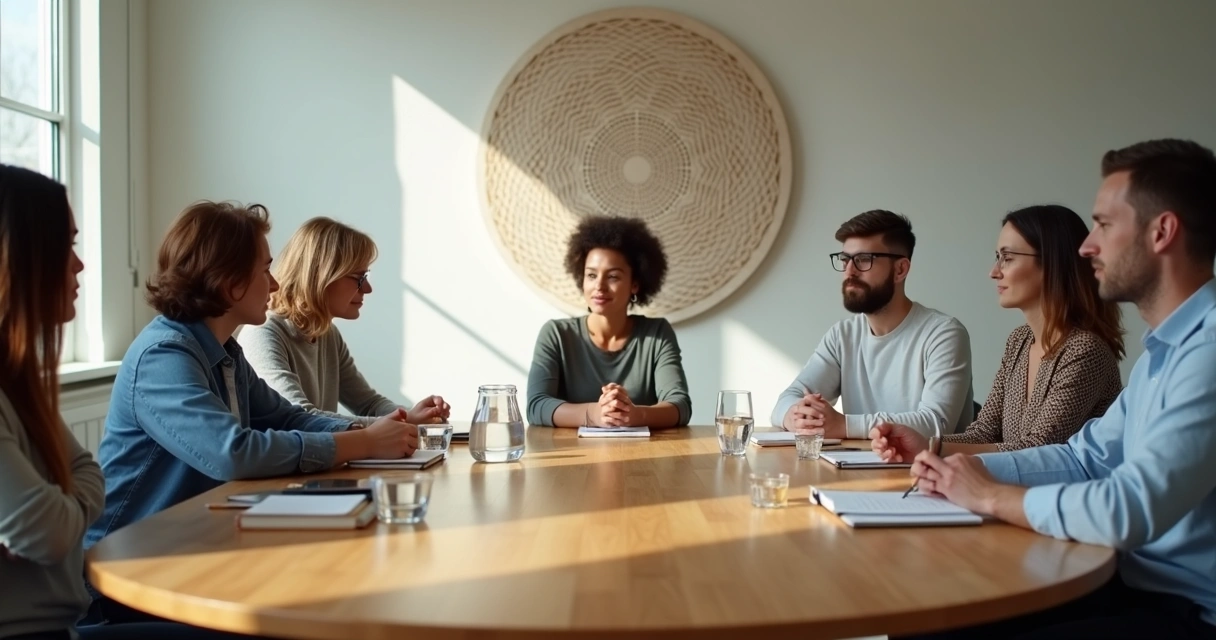
We often think group awareness fails because people are distracted, rushed, or stressed. That is true, but it is not the full picture. In our experience, collective mindfulness is also weakened by hidden mental habits. These habits shape what groups notice, what they ignore, and how they react to tension.
Collective mindfulness breaks down when groups stop seeing clearly together.
A team can sit in the same room, hear the same facts, and still move in the wrong direction. We have seen this happen in work meetings, family decisions, and community spaces. No one meant harm. Still, the group drifted. Quietly.
Bias grows in silence.
This matters because bias does not only distort personal judgment. It changes the emotional field of the group. It narrows listening, hardens roles, and makes people defend views before they understand them. A large review of studies on cognitive biases in decision-making found that roughly 90% of studies confirmed the influence of one or more biases or heuristics. That tells us something simple. Bias is not rare. It is normal. So if we want more mindful groups, we need to notice the less obvious forms.
Bias 1: Urgency bias
Urgency bias appears when a group treats speed as proof of clarity. We have all felt it. A tense issue comes up, the room gets uneasy, and someone says, “We need to decide now.” Sometimes that is true. Often it is just discomfort wearing the mask of action.
When urgency takes over, reflection looks weak. Questions sound like delays. Silence feels unsafe. The group starts to confuse movement with wisdom.
This bias disrupts mindfulness because mindful groups leave room for a full perception of the moment. They do not rush past what has not yet been understood.
A simple way to reduce urgency bias is to pause before closure. We can ask:
What are we reacting to right now?
What fact is still unclear?
What would change if we waited one more day?
These questions sound modest. They can change everything.
Bias 2: Agreement bias
Some groups become attached to harmony. On the surface, this looks healthy. People are polite. There is little friction. Meetings move fast. Yet beneath that calm, disagreement gets edited out.
Agreement bias happens when preserving comfort matters more than telling the truth.
We have seen people hold back a valid concern because they did not want to disturb the tone of the room. Later, the problem grew. This is how false unity forms. Not through trust, but through avoidance.
Mindful groups make space for respectful tension. They do not treat every challenge as conflict. They know that honest difference can protect the whole.
One helpful shift is to invite one dissenting view before closing a discussion. Not to create opposition for its own sake, but to widen perception.

Bias 3: Familiarity bias
Groups often trust what feels known, even when the known pattern no longer fits the present moment. Familiarity bias pulls attention toward old methods, old explanations, and old leaders.
We tend to think, “This worked before, so it must work again.” But conditions change. People change. Context changes.
Collective mindfulness asks for contact with what is real now, not only with what felt safe before. Familiarity bias blocks that contact by making the past feel more reliable than fresh observation.
This bias can be subtle in long-standing groups. People finish each other’s sentences. They assume motives. They stop checking facts because the pattern feels obvious. That is where blind spots begin.
We can loosen this bias by asking the group to name what is different this time. Even three fresh observations can interrupt automatic thinking.
Bias 4: Role bias
Role bias appears when people stop being seen as whole human beings and become fixed functions. The manager becomes “the decider.” The quiet person becomes “the observer.” The emotional one becomes “the difficult one.”
Once this happens, the group listens through labels. It no longer receives each person directly.
This hurts mindfulness because mindful attention is alive and open. It notices the person in front of us, not just the role we assigned them months ago.
We have noticed that role bias is stronger in groups under strain. Stress makes people simplify each other. It feels easier. But it also makes the group less intelligent.
To reduce role bias, we can rotate who speaks first, who asks questions, and who sums up the discussion. Small changes in structure often reveal hidden capacities in people.
Bias 5: Emotional contagion bias
Emotions move through groups fast. One anxious voice can shift the room. One cynical comment can flatten curiosity. One defensive reaction can make honesty disappear.
Emotional contagion bias happens when shared feeling replaces shared seeing.
This does not mean emotion is bad. Quite the opposite. Emotion carries data. But when a group absorbs a mood without naming it, the mood begins to lead thought.
We once watched a calm discussion turn rigid after one person expressed alarm with great certainty. No new facts were added. Still, the group narrowed. That is the power of unexamined emotional spread.
Mindful groups learn to name the emotional climate without shame. A short sentence helps: “There seems to be fear in the room.” Naming is not blaming. It is grounding.
Bias 6: Moral superiority bias
This one is often missed because it hides behind good intentions. A group may believe it is more aware, more ethical, or more humane than others. The moment that belief hardens, listening weakens.
Moral superiority bias makes self-correction harder. The group assumes its motives are so good that its blind spots must be small. That is rarely true.
Collective mindfulness needs humility. Not self-doubt, but humility. The kind that lets us say, “We may still be missing something.”
Without that stance, groups become selective. They notice harm done by others more quickly than harm done by themselves. In serious matters, that split can damage trust for a long time.
Good intent is not clear sight.
Bias 7: Closure bias
Closure bias is the desire to end uncertainty too soon. It often appears after a hard conversation. The group is tired. People want relief. So they accept the first neat explanation.
This can sound mature. It can even sound wise. But sometimes the clean answer is only a fast answer.
Mindfulness in groups includes the capacity to stay with incomplete understanding for a little longer. Not forever. Just long enough for a deeper pattern to emerge.
Closure bias is especially risky when the issue has emotional layers, mixed interests, or hidden history. In such cases, quick certainty usually leaves something outside the frame.
We think one of the healthiest group habits is to end a discussion with one open question still alive. That keeps awareness moving.
Conclusion
These seven biases are easy to miss because they often look reasonable in the moment. Speed looks decisive. Harmony looks healthy. Familiarity looks safe. Roles look efficient. Shared emotion looks like unity. Moral confidence looks principled. Closure looks mature.
Yet all of them can thin the attention of a group. They can make people see less while feeling more certain.
Collective mindfulness grows when groups notice not only what they think, but how they come to think it.
That is the real practice. We learn to pause together, question our shared habits, and widen the space between reaction and response. In that space, better judgment has a chance to appear. So does more honest human contact.
Frequently asked questions
What is collective mindfulness?
Collective mindfulness is a group’s shared ability to stay aware, notice signals early, and respond with care instead of reacting on autopilot. It means people pay attention not only to tasks and outcomes, but also to tone, assumptions, and emerging risk.
What are the main types of bias?
The main types of bias include cognitive, emotional, and social biases. Cognitive biases affect how we judge facts. Emotional biases shape perception through mood and stress. Social biases arise from group pressure, roles, status, and the desire to belong.
How do biases disrupt group decisions?
Biases disrupt group decisions by narrowing attention, distorting facts, and making some voices seem more valid than others. They can push groups to rush, avoid disagreement, copy old patterns, or accept simple answers before real understanding is reached.
How can teams reduce these biases?
Teams can reduce bias by slowing down key decisions, inviting dissent, rotating roles, naming the emotional climate, and checking assumptions out loud. Short pauses, clear questions, and honest reflection help groups think with more balance.
Why is mindfulness important in groups?
Mindfulness is important in groups because shared awareness improves listening, trust, and judgment. When people are present together, they notice risk sooner, handle tension with more maturity, and make choices that reflect the full situation instead of a narrow reaction.